
Abuela - Prologue (Pre-Release Draft)
Abuela - Tucson - 1986
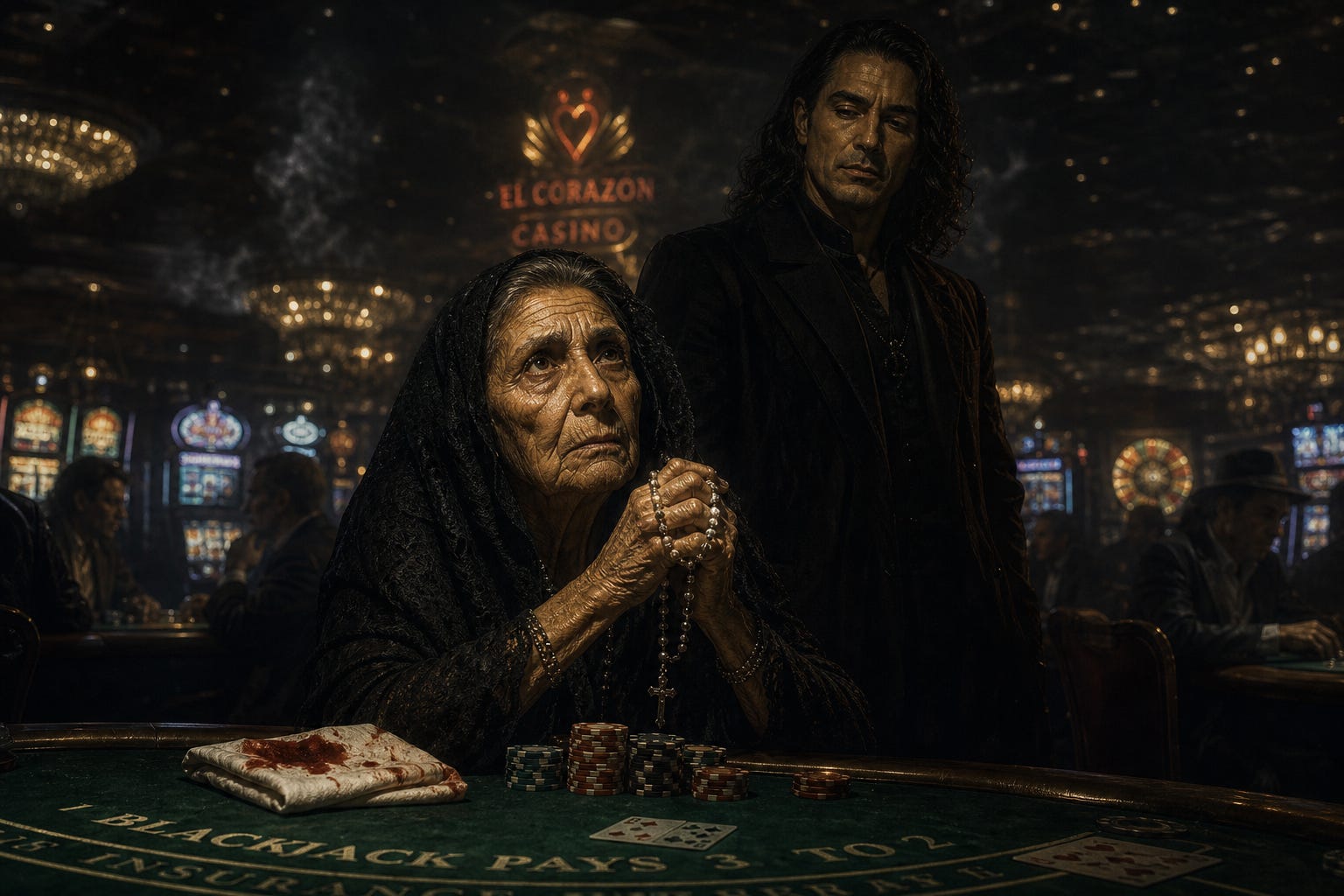
The pain had become a companion now, constant and gnawing, the kind that made her understand why people spoke of cancer as something living inside them. It ate at her bones with teeth that never stopped working, stole her breath in the middle of sentences, turned food to ash in her mouth before she could swallow. The metallic taste never left anymore, copper and rot mingling on her tongue even when she hadn’t coughed blood for hours. Thinking felt like wading through mud, exhaustion settled so deep in her marrow that lifting her hand to cross herself required conscious effort. Three months, the doctor had said, his face carrying that particular blend of professional sympathy and personal relief that he wasn’t the one dying. Maybe four if she was unlucky.
She’d lost thirty pounds she couldn’t afford to lose. Her Sunday dress hung on her frame like fabric draped over a skeleton, the good black one she’d worn to her husband’s funeral twenty years ago, to her son’s military service, to her daughter’s overdose memorial. It still smelled faintly of moth balls and the myrrh-scented candles she lit every Thursday evening, a ritual she maintained even now, even when standing for more than ten minutes made her cough blood into her handkerchief.
The casino lights felt too bright, artificial stars that turned the cigarette smoke into something holy and terrible at once. Slot machines chirped and sang their electronic songs around her, cheerful noises celebrating other people’s small victories while her chips disappeared one hand at a time. A cocktail waitress paused at her shoulder, offering something colorful in a plastic cup, but she waved the woman away with a trembling hand. Liquids came back up now, everything did, her stomach a traitor that rejected even water most days. She sat at the blackjack table with her purse clutched in her lap, social security checks counted twice, exchanged for chips that clicked against each other with a sound like rosary beads. Her hands shook. They always shook now. Somewhere behind her, someone laughed at a joke she couldn’t hear, the sound casual and light, highlighting how utterly alone she was even in a room full of strangers.
A coughing fit took her without warning, the kind that doubled her over and made the other players shift in their seats with the particular discomfort of strangers watching someone suffer. She tasted copper, felt the wet heat of blood on her lips, dabbed at her mouth with the handkerchief already stained rust-brown from previous episodes. The dealer’s expression flickered between concern and irritation. She was slowing down the game.
“You okay, ma’am?” someone asked, the words perfunctory, the tone hoping she’d say yes so they could all pretend nothing was wrong.
She nodded, straightened as much as her spine would allow, and pushed another stack of chips forward. The cards came. She lost. The pattern had held steady for the past hour, her modest pile dwindling with the mathematical certainty of a house advantage that never slept, never tired, never knew what it meant to sit alone in the dark counting the days until everything ended.
This wasn’t for her. The thought circled through her mind like a prayer, the only thing keeping her in the chair when her body screamed to lie down, to rest, to surrender. She was dying anyway; money meant nothing to a corpse except as something to leave behind. Her grandchildren were grown now, scattered like seeds in wind, doing their best to survive in a world that didn’t care about adobe houses or saints’ stories or the kind of faith that held even when God stayed silent. She’d failed them in a hundred small ways, been too poor, too broken, too consumed by grief to give them what they needed.
But this. This she could do. Leave them something tangible, something more than debts and worn furniture and a house that would probably be condemned within a decade. Real money. Real hope. Proof that she’d existed and loved them even when love hadn’t been enough.
The dealer swept away her chips. She counted what remained. Not enough. Nowhere near enough to matter.
She pushed the rest forward anyway, watching the cards fall with the detached focus of someone who’d already made peace with loss. The dealer showed twenty. She had sixteen. The mathematics were simple. The outcome inevitable.
“That’s rough luck, ma’am.” The dealer’s voice carried genuine sympathy this time, the kind that came when someone recognized desperation rather than entertainment. “Maybe call it a night?”
She started to gather her purse, her body already anticipating the walk to the bus stop, the long ride back to an empty house where her grandmother’s crucifix watched from the wall and La Virgen de Guadalupe kept silent vigil from her corner shrine. Only months of living left in her at this point, maybe less if the cancer kept its current pace, and she’d wasted the last of her savings on cards that had fallen exactly as probability dictated they would.
“You’re not doing this for yourself.”
The voice came from beside her, quiet and observant, carrying an accent she couldn’t quite place. Not local. Not foreign. Something in between, as if the speaker had learned English from many sources and synthesized them into something unique.
She turned. The man stood at her shoulder, olive-skinned, his features somewhere between Mediterranean and Middle Eastern, like the faces in her childhood church paintings, the ones showing Christ’s disciples gathered around tables or walking dusty roads. He was timeless in a way she couldn’t articulate, dressed simply, his clothes carrying a quiet quality rather than show. His eyes held the particular stillness of someone who’d learned to watch, to understand what lay beneath the surface of human behavior.
“Excuse me?” Her voice rasped, throat raw from coughing.
“The money.” He gestured at the empty space where her chips had been. “You’re not gambling for yourself. Someone who plays for greed has a different look in their eyes. Hunger. Desperation for more. You have something else. Resignation, maybe. Or purpose.”
She should have been offended, should have told him to mind his own business, should have gathered her dignity and walked away. Instead, she found herself speaking truth to a stranger because dying people had less reason to lie.
“My grandchildren.” The words came out barely above a whisper. “I wanted to leave them something. Anything. I’ve already failed them in every way that mattered. I thought maybe I could at least give them money, let them know someone cared enough to try.”
“And the house is taking it instead.”
“The house always takes it. That’s how gambling works.” She clutched her purse tighter, feeling the empty weight of it. “I should have known better. Should have saved it, divided it fairly, mailed them checks with letters explaining. But I thought maybe, just this once, God would let me win something that mattered.”
The man studied her for a long moment, his gaze carrying the weight of assessment without judgment. Finally, he pulled out the chair beside her, settling into it with the ease of someone who belonged exactly where he chose to sit.
“May I?” He gestured at the table.
“It’s a free country.” She didn’t have the energy to care who sat where anymore.
The dealer looked between them, shuffling cards with practiced efficiency. “Table minimum is five dollars.”
The stranger placed money on the felt, received his chips, and arranged them with careful precision. Then he leaned slightly toward her, his voice dropping to something conspiratorial and oddly gentle.
“Do you know what it means to cast lots?”
She blinked. “Like in the Bible? The soldiers at the crucifixion?”
“Among other places. The apostles used it to choose Matthias. The Israelites used it to divide the Promised Land. Even today, your faith speaks of stewardship and faithfulness, of using what you’ve been given to serve others rather than yourself.” He paused. “There’s a difference between gambling for greed and casting lots for love.”
“I don’t understand.”
“Watch.” He placed his bet, received his cards, and played with a precision that seemed less about calculation and more about reading patterns in dealer behavior, in the shuffle, in the subtle tells that marked someone who dealt the same cards hundreds of times each shift. He won. Then won again. Not dramatically, not in ways that drew attention, but with the steady accumulation of someone who understood probabilities at a level beyond mere mathematics.
Between hands, he explained in quiet tones that wouldn’t carry beyond their corner of the table. How to watch the dealer’s rhythm, anticipate based on their patterns, read the micro-expressions that telegraphed what came next.
“Watch his left hand when he reaches for the shoe—see how his pinkie lifts slightly before a face card? Small tells, but consistent.”
Not cheating in any sense that involved marked cards or sleight of hand, but rather observation elevated to something approaching art. His hands when he demonstrated were steady and unmarked, but carried the particular grace of someone who’d performed the same gestures across centuries rather than years.
“You’re not playing against the cards,” he said softly, his voice felt less like instruction and more like benediction. “You’re reading the human patterns beneath them. The dealer wants to go home, wants their shift to end, has small habits they’ve repeated ten thousand times until they’re invisible to everyone except those who truly see.”
She tried. Her hands still shook, her breath still came short, the pain still gnawed at her bones with relentless hunger. But she watched as he’d taught her, looked for the small tells he’d identified, and placed her next bet with something approaching confidence.
She won.
The chips slid toward her, not a fortune but more than she’d started with. She stared at them, her breath catching, one hand pressing against her sternum where something had cracked open that hurt worse than the cancer. A sound escaped her throat, half gasp and half sob, quickly stifled.
“Again,” the stranger said gently, his voice carrying absolute certainty. “For them. Not for yourself.”
She played. Won. Lost once but won twice more. The pile grew slowly, steadily, each addition feeling less like luck and more like something earned through attention and love transformed into careful observation. The dealer changed shifts. The new one had different tells, different patterns. The stranger pointed them out with the patience of someone teaching a skill they genuinely wanted her to master.
An hour passed. Maybe two. Time felt elastic, measured not by the casino’s timeless interior but by the growing stack of chips in front of her and the decreasing pain in her chest, as if purpose had temporarily anesthetized the worst of her suffering.
Finally, she pushed back from the table, hands gathered around chips that represented more money than she’d dared hope for. Not a fortune that would make her grandchildren wealthy, but enough to matter. Enough to let each of them know someone had fought for them in the way that remained available to a dying woman with nothing left but love and desperation.
She turned to thank him, to ask his name, to understand who would take the time to teach casting lots to a stranger with death in her bones and hope in her heart.
His hand touched her shoulder briefly, a benediction without words, then he turned and disappeared into the casino crowd with the ease of someone who’d perfected the art of arrival and departure without drawing attention.
“Wait,” she called, but her voice came out as a whisper, and then another coughing fit took her, doubled her over, stole her breath and filled her handkerchief with fresh blood.
When she looked up, he was gone.
She sat there clutching her winnings, chips digging into her palms, and wept with gratitude and relief and something else she couldn’t name. The tears came hot and desperate, carrying thirty pounds of lost weight, months of borrowed time, and a lifetime of failures she’d tried to redeem with money won through love rather than greed.
The casino lights still felt too bright. The smoke still hung in artificial halos. But the pocket of space around her grief had expanded, giving her room to gather herself.
She pressed the handkerchief to her eyes one final time, took a slow breath, and let the tears dry on her cheeks.
She had something now. A gift to leave behind. Proof she’d existed and mattered and loved fiercely enough to learn a new skill while dying.
She didn’t know she’d been marked. Didn’t understand that teaching someone to cast lots for love of others created a connection that transcended mortality. Didn’t realize that the man with Mediterranean features and timeless eyes had seen something in her faith and brokenness worth preserving.
She only knew she had enough now. Enough to matter.
She gathered her chips, walked to the cashier with shoulders straightened despite the pain, and converted her winnings to bills she folded carefully into her purse. The ride home felt different, the empty house less condemning, the crucifix on her wall witnessing rather than judging.
She would divide the money. Write letters. Make sure each grandchild knew this came from love, from someone who’d failed them in life but refused to fail them in death.
She would light candles Thursday evening as always, bake her bread, say her prayers.
She would die as she’d lived: faithful, broken, trying.
Tonight, that was enough.