
Claudia Clearance Crew - Chapter 1 (Pre-Release Draft)
Trip – Crimson Cabaret
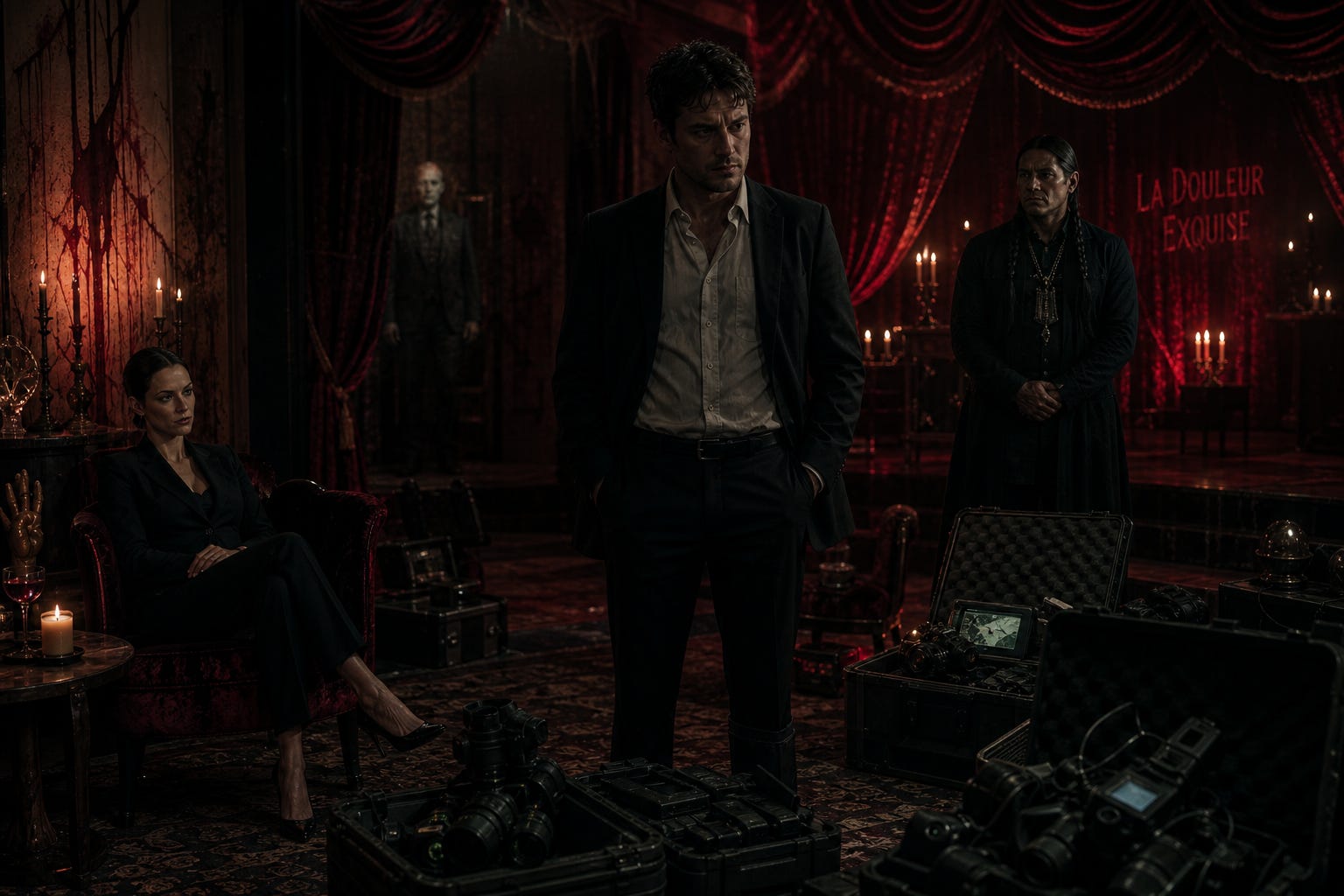
The club smelled of candle wax, blood, and last chances.
The Crimson Cabaret felt wrong after hours—the absence of conversation, of crowd noise, of glasses clinking and movement. The place was too quiet, too expectant. Like the walls were holding their breath. Like the velvet could taste failure. Massive Attack’s “Teardrop” drifted from hidden speakers, its hypnotic beat and haunting vocals creating an atmosphere that felt both clinical and predatory.
Trip stood near the corner of the room, trying not to fidget. He hated this part, the waiting. The feeling of being back in a boardroom without knowing what the meeting was about, or whether someone had already decided he was the problem. His hands were shoved in his jacket pockets, but his shoulders gave him away—tense, curled just enough to suggest he was trying not to fold.
To his left was a pile of assorted equipment, picked out by Vera herself to assist with the success of the mission. Designer cases, high-tech surveillance gear, and what looked like expensive tactical equipment arranged with characteristic attention to aesthetic presentation. The air near the equipment carried the distinct smell of new leather and fresh electronics—the scent of expensive purchases made with good intentions.
He’d been briefed. Kind of. Vera had told him there would be a team. That they’d need to kill child vampires. This was his shot at proving he was useful. That failure meant Asher wouldn’t live to finish grade school.
Then she left him, alone. With his thoughts.
He expected introductions, maybe some team-building conversation. Getting to know each other’s backgrounds, finding common ground, establishing rapport. The kind of professional meet-and-greet that started every successful project team. Names, handshakes, maybe some light humor to break the ice.
This evening, her servant Daniel had dropped him off here at the Cabaret. No details. No warm-up act. Just a bloodstained dress rehearsal for a show Trip didn’t want to star in.
The first to arrive was Daphne, quiet elegance wrapped in tailored black and with an expression that looked like it had been carved with a scalpel. She didn’t say hello. Just walked into the room like she already owned it and sat, crossing her legs precisely.
Her eyes met Trip’s. Cool. Clinical. “You must be the ‘project manager,’” she said, voice clipped with European polish and subtle Irish steel.
Trip forced a smile. “Trip Williams. Yes. Formerly middle management. Currently running damage control for the end of the world. And you are…?”
“Daphne Van Der Groot. Medicine, chemistry, and applied problem-solving. I specialize in systematic analysis and have little patience for deliberate obfuscation.”
“Noted,” he said, clearing his throat. “Honesty’s new to me, but I’ll give it the old college try.”
This was supposed to be onboarding, not initiation-by-immolation.
The door creaked again.
Standing Deer stepped in without a word, shadows clinging to his frame like an old friend. He looked at Trip, not with curiosity or malice, but like someone examining a wounded animal and calculating whether it was worth mercy.
Trip shifted, uneasy.
“Trip Williams,” he offered again. “You with us on this… mission?”
Standing Deer didn’t answer right away. His gaze drifted to Daphne. Then to the velvet curtain behind the bar. Then back to Trip.
“Don’t know you yet,” he said quietly. “So, I’m listening.”
“What do I call you?”
Standing Deer didn’t blink. Didn’t shift. Just stared at Trip like a man who’d spent too long listening to liars and watching bodies rot.
Finally, he spoke, low, even, like dry leaves brushing stone.
“Call me Standing Deer.”
Trip tilted his head. “Is that your name or your call sign?”
A pause.
“It’s what I answer to.”
Trip nodded slowly, swallowing whatever follow-up joke had started forming in the back of his throat. There wasn’t room for levity here. Not with that stare.
Daphne, watching them both, arched one brow. “He listens. That’s more than most.”
Trip muttered, “I’ll take it.”
Before Trip could reply to Standing Deer, the lights above dimmed; not flickered, but dimmed, deliberately and slowly, as if the room itself was holding its breath.
Then he was there.
John Christian didn’t walk in. He arrived the way a shadow arrives when the sun dies—gradual, inevitable, and deeply wrong.
He stepped out of the velvet gloom as if the room had exhaled him. His suit was antique but immaculate, gray wool, faintly frayed, smelling of cedar and old paper. His skin was pale, but not like marble. Like something preserved. Held too long beneath the earth.
His eyes were cold. Not cruel. Just quiet, like no sound had reached him in a very long time.
He nodded to each of them in turn. When his gaze landed on Trip, the air seemed to tighten.
“Trip,” he whispered, the name hollow in his mouth, like a prayer recited at a grave one never believed in.
Trip swallowed hard. “Yes… and you are?”
“John Christian,” he said softly, without inflection. “Once a man. Then a memory. Now… what remains after hunger forgets it ever had a name.”
Trip blinked. His mouth opened, then closed again.
Even Daphne tilted her head, just slightly, studying him like an anomaly under glass.
Standing Deer stood perfectly still, his breath shallow. His gaze drifted to the expensive equipment cases Vera had provided, stacked near the bar like luxury luggage at a hotel. Designer tactical cases, high-end surveillance gear, and what looked like military-grade night vision equipment arranged with artistic precision.
Without a word, Standing Deer moved to the nearest case and flipped it open. He lifted out a pair of night vision goggles, examined them briefly, then set them aside.
“Night vision. For vampires.” His voice was flat, matter-of-fact.
He opened another case, revealing what looked like thermal imaging equipment. “Thermal cameras. To track body heat.” Another pause. “We don’t have any.”
The next case held expensive communication gear. Standing Deer picked up one of the earpieces, studied the interface. “Needs an app to work. And WiFi.” He set it down. “Real useful when you’re bleeding in the desert.”
“Right,” Trip managed. “Glad you could join us.”
John turned slowly, taking in the others. “We’ve been gathered for a task,” he murmured, each word barely audible but carrying the weight of settled earth. “Let us not confuse it for a calling. Some things we do because we must. Not because they can be done cleanly.”
Trip forced a smirk. “You always this cheerful, or is that just a first impressions thing?”
Standing Deer opened another case while the others talked, revealing more expensive communication gear. He picked up another earpiece, studied the interface. “At least she didn’t get us MREs.”
Trip looked up from trying to engage John. “Actually, MREs aren’t a bad idea for extended operations. Caloric density, shelf stability, portion control—” He stopped mid-sentence, his face going blank. “Oh. Right. We don’t… we don’t eat food anymore.”
Standing Deer didn’t look up from the equipment. “There’s that situational awareness.”
John didn’t answer Trip’s earlier question.
He just stood there. Still. Waiting.
And somewhere in the walls of the Crimson Cabaret, the music seemed to grow just a little quieter, as if it, too, were listening.
The silence stretched. Trip shifted again, feeling the heat of three very different kinds of judgment settle on his shoulders like a lead-lined coat.
Standing Deer spoke quietly from his position near the equipment. “We’ll need to trade most of this at a pawn shop. Buy gear that actually works instead of gear that looks expensive.”
“Perhaps we should address the obvious concern directly, Trip. You appear to be the most recently Created individual present. What qualifications do you possess that suggest middle-management experience translates to supernatural crisis operations?”
Trip blinked. His jaw twitched.
“Wow. Right to the jugular. I respect that.” He tried to smile. It didn’t quite stick. “I guess you could say Vera offered me a promotion I wasn’t allowed to turn down.”
Daphne arched a brow. “Coercion does not constitute qualification.”
“Yeah, well, it’s not like I put in a résumé,” he muttered. “Apparently, being in the wrong place at the wrong time is a leadership credential now.”
“Indeed.” She leaned back, lacing her fingers. “I feel compelled to clarify that this operation does not constitute a learning opportunity. If you experience decision paralysis during critical moments, people will die.”
Trip nodded, throat tight. “Trust me. That memo came stapled to the blackmail.”
Standing Deer watched in silence. John Christian closed his eyes briefly, as if in prayer.
No one laughed.
Trip looked down at his shoes. Then up again. “Look, I don’t know if I’m the right guy for this. But I do know what happens if I fail.”
He looked each of them in the eye, one by one. Daphne’s was sharp, measuring. Standing Deer’s unreadable. John Christian’s… still.
“So, I won’t.”
For a moment, the room was still.
Then John Christian spoke, voice soft as grave dirt being shoveled.
“If wishes were thrushes, beggars would eat birds.”
Trip’s mouth tightened. He didn’t respond immediately.
Daphne gave a quiet, unimpressed exhale through her nose. “Translation: Aspirational statements require substantive validation or more colloquially, ‘I’m from Missouri, show me.’”
Trip nodded once. Jaw clenched. “Noted.”
Even the velvet seemed to recoil, like the room itself could smell failure.
Then Daphne cut through it, her voice sharp enough to leave a mark.
“Perhaps you could outline your operational strategy?” She said, using the formal term with precise deliberation.
Trip felt the words hit, like being smacked on the nose with a rolled-up dossier.
He exhaled slowly, forcing a grin that didn’t reach his eyes.
“Right. Plan. Sure.” He stepped forward, more out of instinct than confidence, gesturing toward the table like it might save him.
“Well, assuming we’re all here to not get re-murdered by feral elementary schoolers with fangs, first step is intel. We need actionable intelligence to inform our—” He caught himself, glancing at their faces. “Sorry. Old habits. What I mean is, we need to know how many, where they are, what they’re capable of, and who made them.”
He looked around the room, taking in Standing Deer’s assessment of the equipment, Daphne’s clinical attention, John’s patient stillness.
His voice got quieter. “What am I missing here?”
Daphne tilted her head, just slightly, like a hawk watching something twitch in the grass.
“Why don’t you already possess that information?”
Trip stared at her.
The words hit harder than he expected, maybe because they weren’t wrong. Maybe they felt like confirmation of what he’d already feared—that he was out of his depth, and everyone could smell the blood in the water.
“Then you’re already demonstrating operational dysfunction,” Daphne said with clinical precision. “You are ostensibly functioning as our coordinator, yet you lack fundamental intelligence regarding our objectives. Certainly, you possess the basic parameters. However, you demonstrate no understanding of tactical specifics, operational scope, or resource requirements.”
She stood now, slow and deliberate, her movements surgical in their precision.
“These represent essential data points you should have secured prior to this meeting. If you intend to provide leadership, then demonstrate leadership competency. If you prefer to proceed through improvisation while risking all our continued existence, then continue with this approach.”
Her green eyes locked on his, sharp enough to flay.
“When you possess substantive information to communicate or meaningful decisions to implement, contact me. Otherwise, I would prefer not to waste additional time on procedural deficiencies.”
Trip felt the silence that followed like a slap.
Standing Deer didn’t move, but his eyes were on Trip, measuring again.
John Christian gave no outward sign of reaction. Just the softest breath through his nose. A faint shift of weight. A pause in eternity.
Trip didn’t move. He couldn’t. His thoughts were screaming, clawing at the inside of his skull.
You’re the pitch deck. The fall guy. The idiot in the suit while the wolves circle.
She’s right. You’re flailing. You’re drowning. Let go. Sink. You don’t belong here.
You said you wouldn’t fail. So don’t.
Trip’s hands dropped from the table. He straightened. Not enough to look like a leader, but enough to keep standing.
“Understood,” he said quietly. “Message received.” He paused, then said, voice tight but steady. “I’m sorry. This is my… third? I think? Day as one of you.”
That hung in the air for a moment.
Daphne didn’t look away. But something in her expression shifted marginally. A data point was logged. An equation adjusted.
John Christian, still as a statue, finally moved, just a slow nod, like a priest acknowledging confession.
Standing Deer gave no expression, no judgment. Just a soft murmur, “Then don’t waste your fourth.”
Trip nodded.
One more night. One more call I don’t screw up. That’s all I need.
“I won’t.”
There was no formal dismissal. No signal. Just a shift in weight. A subtle exhale.
Standing Deer stepped back from the table, already reaching for one of the equipment cases. “I’ll take this junk to a pawn shop. Come back with gear that works.”
He gave Trip one last glance—not hostile, not warm. Just the look of a man who had buried too many friends to waste time on unproven ones.
Then he was gone, slipping through the shadows like smoke off a dying fire.
John Christian lingered a moment longer. His eyes fixed on Trip with that still, sunken depth, like he was trying to see whether Trip had a soul left under all the new rot.
Then, just above a whisper, “Fear is a compass. Point it at your guilt, and walk the other way.”
He turned without another word and vanished into the darkened hallway beyond the stage—no sound, no fanfare, just absence.
Trip stood there, breath shallow, heart trying to remember what rhythm felt like.
The room felt heavier now. Not from the silence, but from the fact that one person hadn’t left.
Daphne.
She hadn’t moved.
She remained seated, one leg crossed neatly over the other, eyes fixed on him—not cold now, but analytical. Her fingers drummed once against her knee. Then stopped.
“Three nights old,” she said, as if testing the words out loud.
Then, under her breath, she muttered an old Irish expression of disbelief, clipped and incredulous, “Trí oíche fós fliuch, Dia linn.” Three nights still wet, God help us.
She looked at him again, sharper now.
“You’re still experiencing post-Embrace physiological adjustment. Your body hasn’t properly metabolized its current state. Your Beast remains barely restrained. Your survival instincts are compromised. And you’re already being manipulated as an expendable asset in someone else’s strategic calculations.”
Trip’s jaw tightened, frustration bleeding through his voice. “Are you going to walk out too? Because I didn’t ask for this job, lady. I didn’t volunteer to be anybody’s project manager. I got railroaded into this whole nightmare, and if I fail, my son dies. So, if you’re planning to bail like the others, just do it now so I can figure out how to clean up this mess myself.”
Daphne’s gaze narrowed.
“Not presently.”
She leaned forward, and something in her voice hardened, the clinical detachment cracking just enough to let something sharper through.
“Look, I get it. Your son’s life is on the line. Vera’s got you by the throat. You didn’t choose this nightmare.” Her accent sharpened slightly, Irish steel bleeding through the polish. “But here’s what you need to understand, Boyo—that desperation? That’s exactly why she picked you.”
She sat back, but her eyes stayed locked on his.
“You think she chose you because you’re leadership material? Because you’ve got some hidden tactical genius? Christ, no. She chose you because you’re controllable. Because you’ll do anything—absolutely anything—to keep your boy alive. And when this operation goes to hell, and it will, she’s got the perfect fall guy. The grief-stricken father who was in over his head from day one.”
Her voice got quieter, but somehow more cutting.
“The rest of us? We’ve got established Elder relationships. Stephens, Ochoa, Mireya—we might survive the political fallout if this complete and utter shite-show goes south. We might even keep our positions. But you?” She shrugged with clinical detachment. “You’re the expendable asset. The moment you stop being useful, or the moment keeping you alive becomes inconvenient, you’re dead. And your son?”
Another beat, deliberate.
“Well, dead men can’t protect anyone.”
The lights above flickered—not broken, just uncertain. Like the Cabaret itself was deciding whether to bet on him.
Trip stood there, alone with the woman who had just dissected him with surgical precision, the weight of her words settling like lead in his chest.
He’d thought the night couldn’t get worse.
He’d been wrong.