
Rocket - Chapter 1
Naida - US/Mexico Border

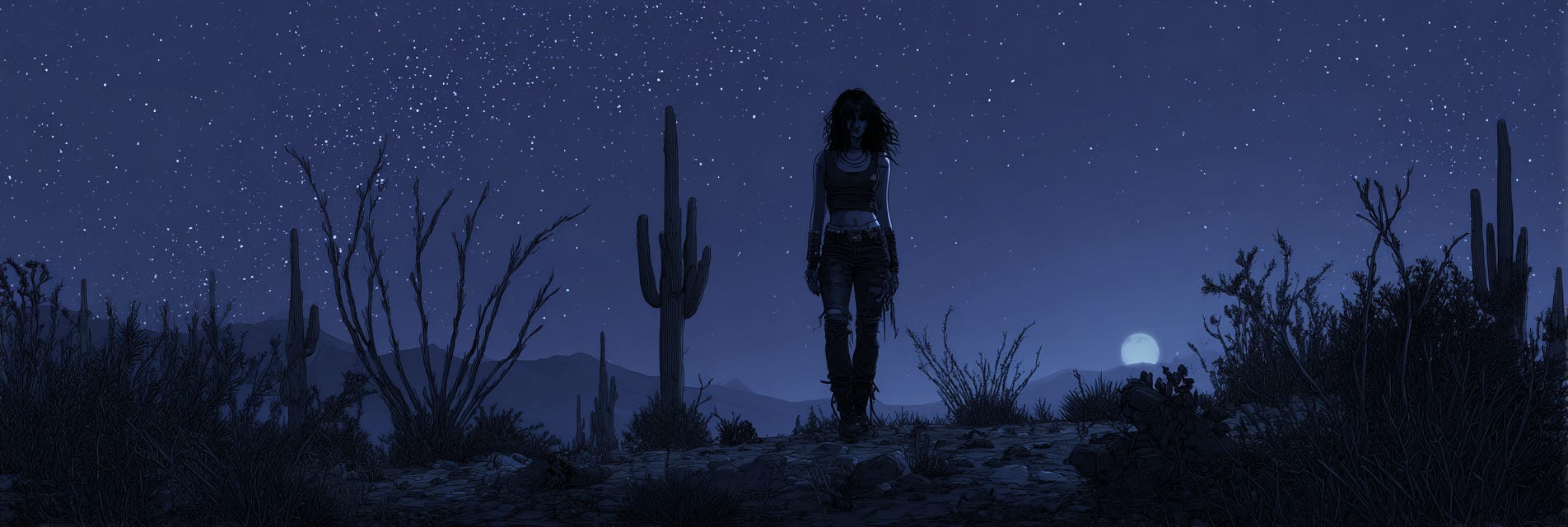
Darkness.
Absolute suffocating black pressed against her face, not the soft dark behind closed eyes, but total, all-consuming. She couldn’t move. Couldn’t scream. Grit filled her mouth. Dirt packed against her palate.
Dirt. There’s dirt in my mouth. Why is there...
She inhaled instead of expelling. Earth flooded her throat, her nose, packed tight against her soft palate. Her body convulsed, desperate to cough, to clear her airway, but there was nowhere for the air to go. No air to draw. Just more dirt.
CAN’T BREATHE. BREATHE. CAN’T.
Panic slammed into her. Her arms were pinned against her sides by walls that pressed in from every direction. Her legs bent at unnatural angles, folded into a space too small, too tight, too WRONG. She thrashed and gained maybe an inch before the earth stopped her cold.
Buried. She was buried.
No no no no NO...
The realization detonated what little control she had left. She clawed at the dirt above her head with fingers that scraped uselessly against packed earth. Her lungs should be screaming. Burning. Dying.
But they weren’t.
The thought cut through her panic like ice water. She was choking on dirt, couldn’t draw breath, should be suffocating, but she wasn’t dying. Shouldn’t she be dying? How long had she been down here? Seconds? Minutes? Long enough that her oxygen should be gone, that her vision should be going dark, that...
Wait. My vision IS dark. Because I’m underground. Not because I’m dying.
She stopped thrashing. Forced herself to stillness despite every instinct screaming at her to move, to escape, to GET OUT. Her chest wasn’t moving. No rise and fall, no desperate gasps. Just... stillness. The dirt should have been choking her to death. It wasn’t.
It wasn’t.
Why am I not dead?
The question opened a door in her mind she hadn’t known was there. In the hollow space, a hunger stirred, tasting the dirt and finding it wrong, insufficient, irrelevant.
Because she didn’t need to breathe.
The realization should have been impossible. Should have been terrifying in its own right. Instead, it flipped some switch in her brain, shutting down the human panic and replacing it with something colder. Sharper. An assessment: the dirt not a death sentence but an obstacle.
Her fingers, which moments before had been scraping uselessly at compacted earth, suddenly possessed strength that didn’t belong in a sixteen-year-old girl’s hands. Heat bloomed in her palms, not warmth she could feel from the outside, but something deeper: embers banked in her marrow.
She tore through the soil above her head. Not frantically now, but with methodical efficiency. Handful after handful, each scoop bringing her closer to whatever waited above. The dirt was loose near the top: hasty work, a digger in a hurry.
Maybe they thought I was already dead.
Maybe they were right.
The first touch of night air against her dirt-caked face felt like salvation and violation in equal measure. She burst from the earth not gasping, though some part of her brain tried to remember that reflex, but tasting the air like a predator scenting prey.
Then her body remembered what her mind had forgotten: she’d been breathing dirt.
She pitched forward onto hands and knees, throat convulsing. The reflex was automatic, violent, her body trying to expel what shouldn’t be there. She gagged, choked, and finally vomited. Dirt mixed with blood mixed with the last meal she’d eaten as a human, beans, and rice from a gas station somewhere in Sonora, back when food meant anything besides memory. The taste was copper and rot and something that had been dead inside her too long.
She spat repeatedly, clearing her mouth of grave-soil and worse. Stringy saliva mixed with dark clots that might have been blood or earth or both. The physical purge did nothing for the wrongness thrumming under her skin, but at least she breathed again.
Yet she needed no breath.
The realization hit her again, sharper this time. Her lungs sat empty and still. She’d expelled without air, expelled matter without respiration, cleaned her mouth through pure muscular reflex rather than biological necessity.
The stars overhead were too bright, too sharp, each point of light carving itself into her retinas with surgical precision. The world had been painted in colors that didn’t have names, shadows that moved with purpose, and air that carried stories from kilometers away. To the south, the border wall ran in both directions, a long black line in the dark, snaking across the high desert scrub. A pale caliche strip of CBP patrol road paralleled it on the US side, empty.
Sound slammed into her amplified hearing like artillery, an avalanche of detail her old human ears had never had the apparatus to receive, every layer of the night announcing itself simultaneously and demanding to be sorted: wind hissing through palo verde branches with the dry papery whisper of leaves that had no soft edges left, a kangaroo rat scratching fifty yards distant, the small frantic percussion of an animal that did not yet know there was a new thing in the desert and would not get the chance to learn, electrical lines humming their deadly song across the high desert as far north as her hearing reached and beyond, an industrial hymn that had been there her whole life without ever having found her ears before. Scents flooded her nostrils in overwhelming waves, layered the way paint was layered on an old door when you finally took the heat gun to it, every coat below the top one still preserved and now suddenly present at once: creosote bush and brittlebush sharp enough to taste, the metallic taste of iron in ancient volcanic rock that had not weathered in living memory, the lingering musk of javelinas that had passed through hours before her death and were still announcing themselves to a girl who was no longer the girl they had passed.
A desert wind picked up, carrying information she shouldn’t be able to process: the pull of the San Pedro drainage miles to the east, the dry arroyo cuts on the Mexico side still holding the scent of yesterday’s rain, the age of coyote tracks in the dust, the way moonlight reflected off mica deposits in the caliche hardpan. The breeze felt different against her skin now, data beyond temperature and pressure: survival encoded in the air itself.
Her lungs sat still in her chest, quiet as stones at the bottom of a well.
I’m dead.
Terror should have gripped her. Instead, it was the first thing that didn’t sound like complete bullshit in weeks. She was dead, and yet she was thinking, moving, feeling. Dead but not finished.
She sat up slowly, dirt cascading from her shoulders like shed skin. Her clothes were ruined: crop top torn across one shoulder, jeans shredded at the knees, both stained with earth that clung to her like evidence. Her black hair hung in matted tangles around a face that looked too young for the hunger that gnawed at her insides.
She caught a glimpse of her hand in the starlight and froze. The warm brown skin that had marked her as daughter of Managua had drained to café con leche, still Latina, but bleached by death into shadow. Her fingers looked delicate now, almost porcelain, but she could feel the steel-cable strength coiled beneath the surface.
¿Qué me hicieron?
At the head of her crude grave, two sticks had been lashed together with a rubber band, forming a mockery of a cross. Beneath it, folded paper waited like a punchline to a joke she didn’t want to understand.
She plucked the note free with fingers that trembled, from restraint, not cold. The paper was cheap thermal receipt paper, already starting to fade at the edges. CVS, according to the header. Someone had bought Advil, energy drinks, and condoms three days ago.
But underneath the mundane receipt smells, her enhanced senses caught something else. Something that made her newly awakened vampire instincts prickle with recognition: the metallic sweetness of vampire blood, faint but unmistakable, as if whoever had handled this paper had done so with bloody fingers. And threaded through that, gunpowder. Recent. Still sharp enough to make her nostrils flare.
The back was covered in hasty ballpoint pen, pressed hard enough to tear through the flimsy paper in places.
Querida,
If you are reading this, you have passed the first examination. Interesting, isn’t it, how quickly your body learned what it needed to survive? Most never wake up. Most accept the soil as their final lesson. But you... you clawed through six feet of earth like it was tissue paper. That tells me everything I need to know about who you really are. ]]
Examination.
Not a test or a game, but an evaluation. Someone had been watching, measuring, deciding whether she was worth the investment of immortality. The writer was right; she had torn through packed desert soil like it was cotton batting. But how did they know that? How did they know she would wake up at all?
The truth is simple: you died in that hole. Your mortal heart stopped beating, your human lungs stopped breathing, your old life ended completely. What emerged is far more valuable. You are vampire now, immortal, powerful, beyond the small concerns that once limited you.
Dead. The word should have sent her into denial or panic, but it felt like the first honest thing anyone had told her in weeks.
Vampire.
The movies had lied about everything else; why should this be different? But the evidence surrounded her: the grave, the note, the way every sense had been cranked to eleven.
The cost? You will feed on blood instead of food. You will walk in darkness instead of light. You will become a predator instead of prey. Doesn’t that sound like exactly what you’ve been preparing for your entire life?
Her mouth watered at the mention of blood. Her teeth ached. Hunger clawed at her gut, abandoning food, fixating on the pulse of living blood. Blood called to her the way chocolate had when she was little, when Mami would bring home a single piece of dark Venezuelan chocolate and she’d smell it through the wrapper for hours before letting it melt on her tongue. But this was deeper, more urgent. This was survival disguised as craving.
Predator not prey. Yes. Know what you are. No cargo. No merchandise. No victim.
The words turned like a key in an unknown lock. How many times had she been the prey? How many hands, how many trucks, how many promises that turned into lies?
I buried you just across the border on the gringo’s soil. Consider it your birthright, this land belongs to you now as much as any living citizen. The wooden cross points toward Tucson, where opportunities wait for someone with your particular talents. Don’t let the authorities catch you. Don’t let the sunrise find you unprepared.
Birthright.
Not illegal entry, not smuggling, not trafficking. Birthright. Her gaze drifted to the horizon where golden light gathered against the deepening sky. Opportunities. Someone thought she had talents worth mentioning.
But most importantly, don’t waste this gift by pretending you’re still the girl who trusted the wrong people. That girl is dead. Good riddance.
You are far more interesting now.
Naida’s chest tightened with grief and relief, tangled together. The girl who had trusted a boy’s promises, who had believed in better lives and easy answers, that girl was gone. Buried in this grave along with her human heartbeat. Good riddance, indeed.
The signature was a single elegant symbol, a mark rather than a name: serpent coiled around a flowering vine.
I’ve become far more dangerous now.
Yes. Yes, she was.
She looked toward the horizon, where amber light pooled against the belly of the sky. Civilization. Or at least the promise of it. The cross at her feet pointed in that direction, just as the note had promised.
Don’t get caught by the authorities.
She almost laughed. Border Patrol was the least of her problems now. What were they going to do, deport a dead girl? Send her back to a grave in Mexico?
I need to remember what she said: dawn shows no mercy to the unprepared.
That one carried more weight. Vampires burned in sunlight; that much even Hollywood had gotten right. She squinted up at the stars, trying to calculate how many hours of darkness she had left. Hours remained before daylight, but time felt different now. More precious. More finite, despite her supposed immortality.
She stood slowly, testing her new body’s capabilities. Everything felt sharper, more precise. Her muscles responded with hydraulic efficiency, her senses stretched to encompass details that defied human limitations to perceive.
Take blood. Feed.
The hunger twisted in her stomach, demanding attention. Not just any blood; she could smell the difference now between the metallic tang of old dried blood and the sweet copper richness of what flowed warm in living veins. She needed to feed. Soon. But first, she needed to understand what had happened to her. How she’d ended up in this grave somewhere in the borderlands between Agua Prieta and Douglas, who had put her here, and why.
Necesito sangre. Dios mío, what’s wrong with me?
She patted down her ruined clothing, checking pockets she’d forgotten she had. In the small front pocket of her jeans, the useless one designed for chapstick or emergency change, her fingers found an object that hadn’t been there before...
A small black device, no bigger than a pack of gum. Plastic housing with a single LED that pulsed green every few seconds. GPS tracker.
The drug shipment.
The memory surfaced without warning, impressions, not clear images. Weight pressed against her body during the truck ride. Packages. Parcels taped to her torso beneath her clothes. She’d been carrying something across the border, valuable enough to monitor.
Other fragments tried to surface with it: rough hands, the taste of cheap tequila forced down her throat, tongues that...
No. No, damn it, no. Eso no pasó. That didn’t happen.
She slammed those memories back into the dark where they belonged, the way you slammed a door on a room you’d promised yourself you weren’t going to enter, the way you put a heavy thing on top of a thing that was trying to get out, the way you taught yourself, fast and young and without help, that some closets had locks because the things inside them needed locks. A fullness, a violation that made her clench her thighs together and fight back the urge to scrape at her own skin, an old animal response her body had built when her mind hadn’t been in the room to consult, and the body did not need her permission tonight either.
The sound reached her enhanced hearing before her conscious mind could process what it meant: engines. Multiple vehicles, moving fast across rough terrain. No headlights, but that didn’t matter anymore. She could see in the dark now, tracked movement by sound.
The wind shifted, bringing her their scent before they crested the ridge. Unwashed skin, old tobacco smoke, engine grease, and something darker: the sour-sweet smell of men who spent their lives trafficking human cargo. The desert wind carried their stink: metallic and rotten beneath cheap cologne and fear-sweat.
They were coming for her.
Coyotes. Pendejos.
The word tasted like fear and fury on her tongue. Human traffickers who had bought and sold her like livestock, who had done things to her that her mind refused to remember, who had apparently decided she was worth more dead than alive.
Wrong.
Whatever they thought they were coming to collect, drugs, money, a compliant victim, it was gone. She was something else now. A predator that tore through packed earth, that hungered for blood, that had clawed back from death.
The engine sounds were getting closer. Three vehicles, maybe four, approaching from the south. They would expect to find either a fresh grave or a terrified girl. They would find neither.
Naida rose from her own grave with desert soil still spilling from her torn clothes, and felt her lips curve into the first genuine smile since her rebirth. It wasn’t a nice smile. It was a predator’s smile, mercy long gone.
Let them come. Take them. All of them.
She was dead already. What was the worst they could do?
The LED on the GPS tracker pulsed green in her palm, a tiny mechanical heartbeat in the darkness. She considered throwing it away, leaving them to search empty desert while she disappeared into the night. But that would be running. Hiding.
She was tired of being the victim.
Instead, she slipped the tracker back into her pocket and began walking toward the approaching vehicles. Her bare feet found purchase on rock and sand with supernatural sure-footedness, her body moving through the darkness as if it had been designed for hunting rather than hiding.
The first vehicle crested a small rise about a quarter mile away, its engine growling through the night air. No headlights, but she saw it clearly now: a battered pickup truck with reinforced bumpers and wire mesh over the windshield. Behind it, two more trucks spread out in a loose formation, flanking her position.
They knew where she was. They had always known where she was.
Good. No running. No hiding.
And I didn’t even have to phone Coyote Hut.
Naida started walking faster, her stride lengthening into a pace that wasn’t quite running but covered ground efficiently. The hunger in her stomach twisted tighter, sharpening into close to anticipation.
The last thing she remembered was being cargo in their trucks. They had used her, violated her, transported her across borders like merchandise. Whatever happened after that, whoever buried her, didn’t matter.
Now they were coming to collect their investment.
She was ready to show them exactly what their investment had become.
The trucks were less than a hundred yards away now, engines throttling down as they approached the disturbed earth that marked her grave. She heard voices, Spanish, crude and casual, discussing her like she was livestock that had wandered off.
“La mercancía está aquí. El GPS no miente.”
“¿Está viva?” one of them asked.
“No importa. Tenemos lo que vinimos a buscar.”
They thought she was merchandise. Property. Something to be collected and redistributed according to their business plan.
Wrong again.
Naida stepped out of the shadows just as the lead truck’s driver cut the engine. Three men climbed out, flashlights in hand, their movements casual, and confident. They had done this before. Probably many times.
This time would be different.
“¡Órale!” called the driver, a heavyset man with forearms like tree trunks. “La putita linda. Look who’s awake, chicos.”
The flashlight beams found her, pinning her in circles of harsh white light. She didn’t flinch, but neither did she advance. Instead, she let herself sway slightly, performing disorientation. One hand pressed against her throat, a gesture that could be read as vulnerability or an invitation to look. Her other arm wrapped around her torso, drawing attention to torn clothing while appearing protective.
The illumination revealed what they had come to collect: a sixteen-year-old girl in ruined clothes, standing alone in the desert night, covered in grave dirt. But instead of the defiance they might have expected, she seemed... lost. Fragile. Exactly what they were used to handling.
“¿Dónde estoy?” she called out, her voice carrying just the right note of confusion and fear. Where am I? She took a half-step backward, then forward again, as if each direction held equal danger. The movement was subtle, but it positioned her closer to a cluster of palo verde where the shadows deepened.
“Ven acá, mija,” the driver continued, his voice taking on the false kindness that predators used with prey. “Come here. We’re taking you somewhere safe.”
Naida cocked her head, studying them through eyes that turned the flashlight beams into cold mirrors. When she spoke, her voice was soft, conversational, and absolutely terrifying.
“Safe?” She let the word hang in the air like a blade. “From who?”
The men shared nervous glances, confidence draining from their casual postures. This wasn’t how their collections usually went. The merchandise was supposed to be frightened, compliant, grateful for rescue.
“From whatever chupacabra buried you out here, niña,” the driver said, taking a step forward. “Come on. We’ll get you cleaned up, get you fed. Everything’s going to be fine.”
Naida retrieved the GPS tracker from her pocket, its green LED pulsing, mechanical heartbeat, leash. Then she snapped it in half, its LED going dark permanently. She looked back at the men who had come to collect her like a lost package.
Safe? Seriously? You think I was ever safe with you hijos de puta?
Memories flashed.
The words triggered fragments she’d been fighting to bury.
Zip ties cutting into her wrists. The driver’s voice: “Don’t worry, putita, we’ll take real good care of you...”
Hands reaching in darkness. Her own voice, younger: “Please, I’ll be good.”
Laughter. Cold, predatory laughter.
“Yes, you will, you’ll be real good.”
No. No. I don’t want to remember.
The fragments lasted only seconds before she slammed them back into the dark. But they were enough.
Never again. Nunca más.
The second man, younger with prison tattoos snaking up his forearms, stayed by the trucks. Smart. But the third one, older, with scars across his knuckles, took a few steps closer, close enough that she could read the hunger in his eyes. For power, not for blood like hers. For control. For the chance to break something smaller than himself.
I know that look. I’ve seen it before. You think I’m still cargo. You think I’m still broken.
The driver holstered his flashlight and started walking toward her, hands visible and empty, the classic approach for spooked prey. She’d seen this exact choreography before. Step one: appear non-threatening. Step two: get within grabbing distance. Step three: the mask comes off.
“It’s okay, niña. You’re safe now. We’re going to take care of you.”
Same words. Same tone. Same lie.
Naida let her breathing quicken, eyes darting between the men as if searching for escape routes. But she wasn’t planning escape; she was reading angles, distances, positioning. The driver was ten feet away now, moving with the false patience of a predator who thought his prey was trapped. The scarred man hung back but moved slightly to her left, cutting off what he thought was a retreat path. Standard pincer movement.
Come on. Just a little closer. Leave your friends behind.
“I remember some things,” she said, voice small and uncertain. She let it crack slightly on the word ‘remember,’ as if the memories were too much to bear. “There was a truck. And men who... who were mean to me.”
She wrapped her arms tighter around herself, the picture of traumatized innocence. But the gesture also drew attention to her torn crop top, to the way the fabric clung despite the dirt and damage. When she shifted her weight, it was subtle: a slight arch to her back, a cant to her hips that might appear as defensive positioning or invitation, depending on what the viewer wanted to see.
The driver’s pupils dilated. He was seeing what he wanted to see.
“Please tell me you’re here to help.” The question came with a small step forward, enough to catch the moonlight differently, to highlight rather than hide. Her hand moved to her throat, the gesture reading as nervous, but her fingers traced a line down to her collarbone before stopping.
They taught me this. They taught me how to make them want to get closer. How to make them think they’re getting something for their kindness.
And I’m so fucking good at it. That’s the worst part, but that I remember. Not the details, not their faces, not what they did. But this? The performance? That’s muscle memory now. My body knows what to do before my brain catches up, and I hate it. I hate that it works. I hate that it feels automatic. I hate that some part of me always knows exactly what predators want to see.
Her breathing became rapid and unsteady, torn shirt pulling tight with each inhale, fabric clinging where sweat made it stick, her nipples visible through the thin material in the exact display she knew they’d look for. When she tucked a strand of hair behind her ear, the movement drew attention to the vulnerable line of her neck.
The driver’s expression softened with what he probably thought was compassion but looked more like anticipation. His pupils dilated slightly, from arousal. Arousal that came from having power over something helpless that might, just might, be grateful enough to show appreciation.
There it is. There’s the real you. You think I might be offering payment for rescue.
“Sí, mija. We’re here to help. Just come a little closer, and we’ll get you somewhere safe. Get you warm.”
He took another step forward, now only six feet away. The scarred man moved with him, maintaining the pincer formation, but he was focused on blocking her escape routes rather than watching her hands. Amateur mistake.
You’re not watching my hands. You’re not watching my feet. Just my tits, my hips, my mouth. Same as always.
She took one more step backward, deeper into the shadows where the desert darkness folded around her. The movement brought her to the perfect position: back against a large palo verde, seemingly cornered, but actually protected from behind while having clear striking distance to anyone who approached.
The driver followed, drawn by her apparent distress and his own predatory instincts. Just a few more feet, and he’d be away from his partners, away from the vehicles, away from the light. The scarred man followed too, but hung back slightly, close enough to help, far enough to avoid being grabbed if she tried to use the driver as a human shield.
You’ve thought this through. You’ve done this dance before. But you’re thinking like the wrong kind of predator.
Her enhanced hearing picked up the tattooed man’s voice from the trucks: “Órale, just grab her already. We don’t have all night.”
“Cállate,” the driver snapped back over his shoulder. “She’s scared. We do this right, she comes quiet. We do it wrong, she screams and runs and we’re chasing her through cactus for an hour.”
They’re arguing. Good. Distracted. And you’re worried about me screaming and running.
She let her lower lip tremble, made her voice break, not hard when the memories were so close to the surface. “I just want to go home. I want my papi.”
The word hung between them: innocent need and sexual promise, depending on what he wanted to hear. She knew which version he’d pick.
It was true. She did want to go home, wanted her mama, wanted to be the girl who worried about homework and boys and whether her crop top was too tight. But that girl was buried in a hole in the desert, and what had clawed out was something unnameable.
“I know, mija. I know.” His eyes traveled down her body and back up. “I can be your papi.” The driver moved close enough for her to taste the tequila fumes, catalog the burst capillaries mapping his nose, track the subtle tremor in his hands from whatever uppers were keeping him functional. “But you can’t go home yet. You need to come with us first. I’ll make you feel safe, feel good... Just for a little while.”
Just a little while. Until we’ve used you up completely.
This is wrong. I shouldn’t be this good at playing victim. Real victims don’t calculate angles and plan strikes. But I’m not a victim anymore, am I? I’m the thing that clawed out of a grave and can’t stop thinking about blood. That needs it. That needs them. So why does this performance feel more natural than anything else I’ve done since resurrection?
“I don’t want to get in another truck,” she said, genuine terror bleeding through her careful performance. She never wanted to be cargo again, never wanted to be something transported and traded and consumed.
“You don’t have to be scared,” the scarred man said, moving closer now that the driver had her engaged. “We’re the good guys, remember? We’re here to rescue you. Be a good girl and come to papi.”
Rescue. Right. And I’m sure you’ll want proper payment for your rescue services.
The two men were positioned perfectly now, close enough to grab, far enough from backup, isolated in the shadows where their deaths wouldn’t be witnessed. The tattooed man by the trucks was getting impatient, but he wasn’t moving. He was the smart one, the cautious one. He’d be last.
But first, she had to deal with the volunteers.
“I don’t know if I can trust anyone anymore,” she said, and the vulnerability in her voice was absolutely genuine. She didn’t trust anyone. But not for the reasons he thought.
“You can trust me,” he said, advancing. Near enough that his accelerating heartbeat betrayed exactly the trust he had in mind.
Perfect. Take him. Take the gift.
“Está bien,” Naida whispered, her first genuine smile since resurrection breaking across her face. “I trust you.”
Oh, I absolutely trust you, cabrón, but not in the way you think.
The driver never saw the predator hiding behind the victim’s mask. False reassurance was still dripping from his mouth when her grip closed on his throat, vampiric strength turning his physical advantage into a joke. The heat in her palms flared: banked coals, bone-deep.
“Wrong choice, pendejo.” She pressed her lips to his ear, then bit down, hard, on the rim of cartilage and skin, separating it from his body.
His scream cut through the desert night high and desperate and utterly inhuman. Blood poured down his neck, warm and copper-sweet against her tongue. She spat out the severed ear and smiled wider, letting him see her teeth in the moonlight.
Before he could process what had happened, her free hand struck his throat with surgical precision. Hard enough to collapse his windpipe partially, turning his scream into a wet, choking gurgle. He clawed at his throat with both hands, no longer thinking about grabbing her, no longer thinking about anything except the desperate need for air that wouldn’t come.
His eyes bulged with panic as he fought to breathe through the damaged cartilage. Each attempt to inhale produced nothing but a horrible rattling sound, like air being forced through a broken straw. Saliva and blood from his damaged throat created a frothy foam that bubbled from his mouth as he struggled for oxygen.
His boots scraped against the caliche as she dragged him into the palo verde grove, thorns sealing around them. His hands dropped from his throat to hang uselessly at his sides. His knees buckled, and he collapsed forward against the palo verde, conscious but utterly helpless.
The other two men shouted in alarm, fumbling for their weapons, but she was already moving. She hauled the heavyset trafficker deeper into the darkness beyond their flashlight beams, her predatory strength folding his two-hundred-pound frame like paper.
Yes. Away from light. Away from witnesses. This one now. Then the others.
Behind them, she heard the other Sinaloa Coyotes calling out, their flashlight beams sweeping frantically across the desert, but she was already beyond their reach, swallowed by shadows that parted for her like curtains.
The hunger arrived with mechanical precision, the way thirst arrives when you’ve run too long, not a question, just physics. The man’s pulse hammered against her fingertips, rapid, terrified, a countdown she understood without being taught. His blood whispered promises through his flesh, the same impossible urgency she’d felt clawing toward air when the earth had tried to claim her.
Dios, I know what I am now. I know what I’ve become. Forgive me.
But she was already sinking her teeth into his neck, and God, if He was listening, bore witness to the damned.
The first taste of blood was like coming home to a place she’d never been. Warm copper and salt and something indefinable that tasted like life itself. Her victim’s struggles weakened as she fed, his fingers clawing weakly at the ground before falling slack.
After draining him completely, she finally pulled away, her mouth stained crimson. The man lay still at the base of the palo verde. She assessed it with cold efficiency: threat neutralized, resources acquired, position exposed. The part of her that was still sixteen kept trying to surface. She drowned it.
Yes. Feed. Hunt. Live.
In the distance, she heard the surviving Coyotes shouting to each other, engines starting, the sound of vehicles pulling away in panic. They would tell stories about this night, she realized. Stories about the merchandise that turned into monster, about the cargo that had teeth.
Let them tell their stories.
Naida wiped blood from her lips with her knuckles. Turned north toward Tucson. Her feet knew the direction before her brain made the decision: some new instinct already calculating distance, water sources, cover, feeding opportunities. She followed it. She had a new existence to figure out, and the desert ahead of her ran in waves of low scrub and pale caliche and dry washes that the moonlight rendered as a silver topographic map drawn for a reader she did not yet know how to be, every ridge announcing where the next ridge would lie, every dry channel showing her where water had once decided to travel and would decide to travel again the next time the sky broke open. And apparently something in her already knew how to start, something that had not been hers before the dirt and that was hers entirely now, walking her north on bare feet that found purchase as if the ground had been laid for them.
The hunt was just beginning.
© 2025 E L Frederick | Published by Veridian Studios