
Rocket - Prologue
Naida - Managua

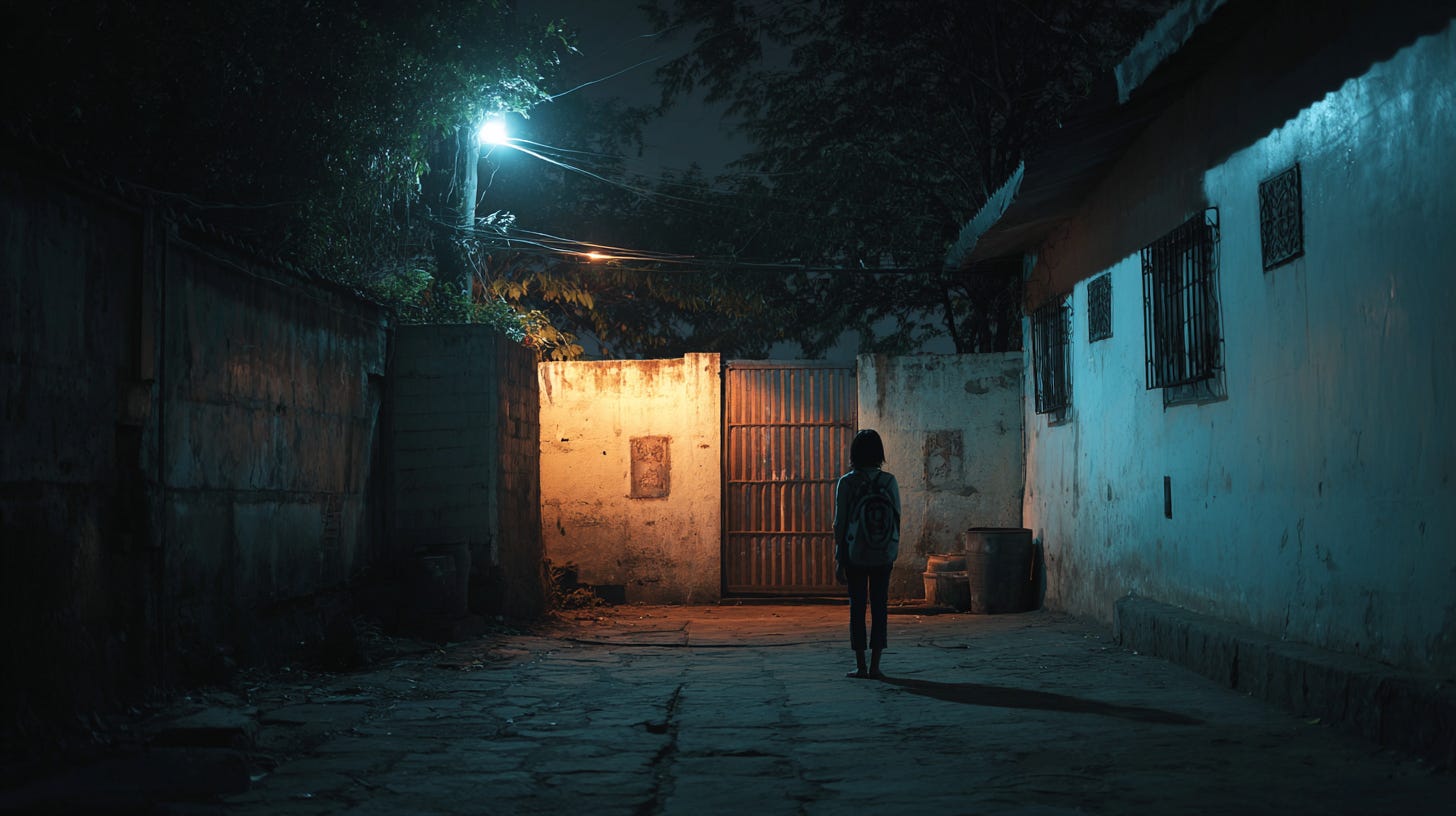
The boyfriend’s house looked different at night. Naida had passed it dozens of times during the day. Walking to school, heading home with friends, those careful afternoon visits when his mother was there and everything felt safe and supervised. Now, standing on the cracked sidewalk with her backpack, three days of surviving packed into one bag, the two-story concrete structure felt like a fortress designed to keep her out, deliberate and weather-stained and obviously built by men who had decided what their family was and was not in the business of taking in. The generator at the pulpería two doors down was still running, that low diesel grind that had been the soundtrack of every Managua summer she’d been alive for, woven so deeply into the city’s nighttime breathing that she only noticed it now because she was standing still long enough to hear what she was about to walk into. Diesel smell, someone’s music bleeding through a closed window in that small distorted way music came through concrete walls in this neighborhood, the dog on the corner doing what it always did, oblivious as dogs got to be when they had owners and food and a corner of their own to defend.
She checked her phone. 10:14 PM. Late enough that the family would be home and settled, early enough that showing up wouldn’t scream emergency or look suspicious to neighbors. The mathematics of desperation: when did you stop being a girl asking for help and become a threat that needed handling?
Her parents had been dead for three days. Crossfire between police and pandilleros two blocks from the market where they’d gone to buy vegetables. Wrong place, wrong time, wrong city to believe you could live a normal life if you just kept your head down and worked hard. The funeral had been yesterday, cheap coffins, cheaper ceremony, extended family who’d shown up long enough to confirm they weren’t taking her in. Including the aunt whose son Naida had told her mother about, years ago. The touching. The locked bedroom door. His fingers invading her body. The things cousins weren’t supposed to do. The son who’d been quietly sent to live with family in León afterward.
“You’re fifteen,” her aunt had said. Not unkindly. “Old enough to work. Old enough to figure it out.”
Old enough to be someone else’s problem.
Naida had figured out plenty during those three days of frantic calls and closed doors. She’d figured out the apartment was already gone. The landlord had come by twice, measuring it with his eyes instead of his condolences. She’d figured out that relatives would drive two hours to stand at a cheap coffin but not twenty minutes to answer a phone. She’d figured out that fifteen-year-old orphans in Managua had three options, roughly, and two of them you didn’t survive.
But she’d also decided: boys were stupid.
The cousin had taught her that, years ago, in ways she still couldn’t think about directly, every attempt skidding past the actual memory. He’d taught her that men wanted things from girls, specific things, and that wanting made them weak and predictable. The boys at school had proved it was true, how easily they’d do her homework, buy her lunch, give her their jackets when she shivered theatrically, all for a smile and a kiss on the cheek and the carefully rationed possibility of more that she knew she would never actually allow.
Mateo had been one of the stupid ones. Sweet, eager Mateo with his nice smile and his modest house and his parents who both had actual jobs instead of scrambling for daily survival. She’d cultivated him carefully over the past year, just enough attention to keep him interested, just enough distance to keep him wanting more. Never anything that would get her labeled a puta by the other girls, never anything that would make his parents forbid him from seeing her.
Until tonight.
Tonight, she needed more than homework help.
She circled to the back of the house, where Mateo’s second-floor bedroom window faced the small concrete courtyard. Light still glowed behind the curtains. He was awake, probably on his phone like every other teenage boy alone in his room at night. She could hear faint audio through the closed window, female voices, exaggerated moans, the kind of sounds that made teenage boys think they understood what women wanted.
Naida picked up three small pebbles from the courtyard. Checked the neighboring windows, all dark. Threw the first pebble.
It clicked against the glass louder than she’d intended. She froze, listening for movement inside the house, but heard nothing except the distant sound of traffic and a dog barking two streets over.
She threw the second pebble. Then the third.
The curtain twitched. Mateo’s face appeared, confused and backlit by his phone. His eyes went wide when he recognized her. She watched him mouth her name silently before he disappeared from view.
Thirty seconds later, the back door opened carefully. Mateo emerged in pajama pants and a t-shirt, phone flashlight illuminating his nervous approach.
“Naida? ¿Qué estás haciendo aquí? It’s late...”
She stepped forward into the phone’s light, letting him see her properly. She’d calculated this carefully. No makeup because she didn’t want to look like she was trying too hard, hair loose because boys liked it down, her best jeans and a fitted shirt that showed she had curves without looking obvious. The backpack stayed hidden in the shadows.
“I’m sorry,” she whispered, making her voice small and frightened. “I didn’t know where else to go.”
His expression shifted immediately from confusion to concern. Perfect. He was so stupid when you gave him a chance to be a hero.
“Your parents...” he started, then stopped, looking uncomfortable. “I heard. I’m so sorry. I wanted to come to the funeral, but my father said...”
“It doesn’t matter.” She moved closer, close enough that he’d smell her shampoo, close enough that he’d feel the heat of her body in the cool night air. She could feel him too, warmth coming off his skin, like he’d just been in bed, and filed it away as useful. “Mateo, I need help. I need somewhere to stay. Just for a little while, until I can figure things out.”
“Stay? Here?” His eyes darted back toward the house, anxiety replacing concern. “Naida, I don’t think my parents would...”
“They don’t have to know.” She let her hand brush against his arm, barely there, contact that promised more. “Just... maybe in your room? I can sleep on the floor. I won’t make noise. Your parents won’t even know I’m here.”
She watched him struggle with it, what he wanted pulling against what his father would do. If she pushed too hard, he’d panic. If she didn’t push enough, he’d find excuses.
“I don’t have anywhere else to go,” she said, letting her voice crack slightly. Not fake tears, she didn’t need to perform that much, but genuine vulnerability wrapped in just enough sensuality to confuse his protective instincts with other, baser urges. “Everyone else said no. You’re the only one who...” She let the sentence trail off, looking up at him through her eyelashes in the way that had always made him fumble for words.
“I want to help,” he said, and she could hear the honesty in it mixed with the fear. “But my father, he’s very strict about girls. About reputation. If he found out...”
“He won’t.” She closed the remaining distance between them, her body almost touching his. She could feel him trembling. “Please, Mateo. Just tonight. I promise I’ll be good.”
The double meaning hung between them. She watched him process it, watched him try to decide if she meant what he hoped she meant.
She’d learned this dance young. Knew exactly how far to lean into the promise without making it explicit.
Mateo opened his mouth to respond.
“Mijo, ¿con quién estás hablando?”
They both froze. The voice came from inside the house, male and sharp with authority. Mateo’s father.
“Nobody, Papá! Just... checking something outside.”
But footsteps were already approaching; the back door swung wider and Mateo’s father stood there in undershirt and pants, his weathered face moving from confusion to recognition to something harder when he saw Naida standing close to his son in the middle of the night.
“Naida.” Not a question. A flat statement that carried judgment in every syllable. “What are you doing at my house this late at night?”
“Señor Morales, I...” She started with the vulnerable routine, but his expression stopped her cold. This was a grown man who’d seen every con Managua had to offer, not a boy she could work with practiced helplessness.
“Her parents died,” Mateo said, stepping between them. “She just needed...”
“I know about her parents.” Señor Morales stepped fully into the courtyard, and suddenly the space felt much smaller. “Tragic. But that doesn’t explain why she’s in my backyard at this hour, standing very close to my son, asking for God knows what.”
The way he said it, cold and knowing, made Naida’s stomach clench. He understood exactly what she’d been doing. Worse, he was assessing in a way she couldn’t handle.
She’d made a study of the different ways men looked at girls her age, an unwilling expertise built by every walk past every doorway and every bus stop in a city that had been quietly assessing her since she was nine years old. The hungry ones, the guilty ones, the ones who pretended not to look at all, the ones who looked and then made themselves look away and the ones who looked and then talked to themselves about what they had just looked at. None of them had ever flipped the mirror, none of them had ever set the small careful machinery of her face and posture and voice in front of her and named it for what it was while she was still standing inside it. Congratulations to Señor Morales: first man in Managua to look at a fifteen-year-old girl and see the hustler instead of the merchandise, and the worst part was the small clean precision of the recognition, the way it came without anger or even much disgust, the way a foreman might assess a tool that had wandered onto the wrong jobsite.
“I just needed help,” she said, abandoning the seduction and trying for honesty. “I have nowhere to go. No family willing to take me in. I thought maybe...”
“You thought you’d manipulate my son into hiding you in his bedroom.” Still flat. Still cold. “You thought a pretty face, empty promises, and some desperate circumstances would make a stupid boy do stupid things.”
“Papá, that’s not...”
“Go inside, Mateo.”
“But I...”
“Inside.”
Mateo looked at Naida with helpless apology, then fled back into the house. The door clicked shut behind him, leaving her alone in the courtyard with Señor Morales.
Naida considered running, but her backpack was still in the shadows and she had nowhere to run to anyway. Her heart was going, actually going, in a way it hadn’t even during the pebbles; she’d been too focused then. She made herself breathe through it. She waited, trying to read his expression, trying to figure out what came next.
“You’re fifteen years old,” he said finally. “Orphaned. No family support. No money. No prospects.” He paused. “In a week, maybe two, you’ll be living on the streets. You know what happens to pretty fifteen-year-old girls on the streets of Managua?”
She did. Everyone did. That’s why she was here.
“I was hoping...” she started.
“You were hoping my son would be stupid enough to shelter you. Maybe sleep with you. Get attached. Maybe even get you pregnant. Make it impossible for his family to throw you out once we discovered you.” His tone suggested he’d seen this exact play before. “But what you didn’t consider is that I can’t have a girl like you anywhere near my son.”
A girl like you. The words hit like a slap.
“I need to protect my family,” Señor Morales continued, almost conversationally. “My son has a future ahead of him. Good grades, maybe university if we can save enough. He doesn’t need a pretty distraction with tragic circumstances pulling him into poor decisions.”
“I understand,” Naida said. Another calculation, another zero. “I’ll go.”
She moved to collect her backpack, but his next words stopped her.
“However.” He pulled a phone from his pocket. “I might be able to help you.”
Something hooked behind her ribs. “Help me how?”
“I have... business associates. People who move cargo north, across borders. They sometimes need workers. Young, pretty workers who don’t have family asking questions.”
She waited for the catch. “What kind of work?”
“Does it matter?” He was already scrolling through his contacts. “You have no money, no family, no options. I’m offering you a chance at a better life. In America. Real opportunity.”
“But what would I be doing?”
“Service work. Hospitality. Entertainment.” He waved the questions away like annoying flies. “The details aren’t important. What matters is you’d be fed, housed, transported safely across three countries, and given real work instead of starving, o puteando, in Managua. Most girls would be grateful for such an opportunity.”
She could name every red flag if she let herself. The vagueness. The speed. The way he’d pivoted from throwing her out to offering salvation. But the alternative was sleeping in parks, selling her body, and hoping the gangs didn’t notice her, and that wasn’t really an alternative at all.
“It sounds... expensive,” she said. “I don’t have money for travel...”
“You work off the debt. Standard arrangement. My associates cover all costs upfront, transportation, papers, housing, and you work for them until the debt is cleared. Fair deal for everyone.”
“How long would that take?”
“Depends on how hard you work. How cooperative you are. How much you’re willing to do what’s necessary.” His smile stopped at his mouth. “But you seem like a smart girl. Resourceful. I’m sure you’ll find ways to be... valuable.”
The way he said valuable made her skin crawl, but what choice did she have? Stay in Managua with nothing? Sleep on streets where girls disappeared? At least in America there were laws, police who weren’t corrupt, opportunities for someone willing to work.
“And the work is legal?” she asked. “I won’t get deported?”
“My associates handle everything. They’ve been doing this for years. Very professional operation.” He was already typing on his phone. “Trust me, you’ll enjoy the work. It’s the kind of thing pretty girls like you are naturally good at.”
That phrase again, pretty girls like you. Like being pretty was both her only asset and her fundamental flaw. Like it explained everything about who she was and what she was worth.
But maybe he was right. Maybe being pretty was the only advantage she had left. She had learned that men wanted certain things from pretty girls. School boys had proved they’d pay for even the hint of getting those things. Maybe in America, where everything was better, she could use that advantage to build a real life instead of just surviving day to day.
“Okay,” she said. “When would I leave?”
“Tomorrow. Be ready at dawn. I’ll have someone pick you up.” He studied her for a moment, something almost pitying in his expression. “You should thank me, you know. Most men would have just called the police and let them deal with a trespasser. Or worse, let the streets deal with you.”
“Thank you, Señor Morales.” The words came automatically, years of forced politeness to adults who held power over her. “I really appreciate...”
“One more thing.” His voice dropped lower, harder. “I’m doing this to protect my son from a puta who tried to seduce her way into my house. Don’t mistake my business opportunity for kindness. You’re a problem that needs to disappear, and my associates pay well for pretty problems.” He smiled without warmth. “Waste not, want not.”
The words landed cold and clear. He was disposing of her. Profitably.
She almost admired the efficiency. Her own con had been a C-minus at best; his was professional grade. Respect where it was due, even when it was selling you.
But what else was there?
“Where should I meet them?” she asked, voice small.
He gave her an address, somewhere in the industrial district, early morning. Then he went back inside, leaving her alone with her backpack and the dark.
But at least she wouldn’t be sleeping in a park tonight.
At least she’d have a chance.
She killed her third question before it finished forming. Lullabies were for girls who could afford to sleep.
She shouldered her backpack and walked. The pavement held the day’s heat under her shoes; somewhere on the main road a bus went by too fast, its exhaust touching her face like a hand. The city was the city. It didn’t care what happened in one courtyard. She told herself America would be better, that the work would be fine, that she was smart and resourceful and pretty and those things would count for something somewhere. Or if they didn’t, she’d make them.
© 2025 E L Frederick. All rights reserved. Unpublished manuscript — do not reproduce or distribute without permission.